


Magnetic flux and flux density
Magnetic flux is analogous to electric current in an electric circuit. Contrary to the terminology, however, there is no flow of magnetic particles; rather, it is symbolically understood as „the amount of magnetic field“ and acts as a result of magnetic tension. The symbol for magnetic flux is \(\varPhi \), and the unit is the weber (Wb). One weber (Wb) is equivalent to one volt-second (Vs).
Apart from the magnetic flux, the force exerted by a magnet also depends on the area through which the flux passes. The denser the field lines are concentrated, the greater the magnetic effect. This is described by the magnetic flux density \(B\), which in the simplest case (non-curved surface, homogeneous flux density) is defined by the quotient of the magnetic flux \(\varPhi \) and the area \(A\). The unit of flux density is Tesla (T). The direction of the flux density \(\vec {B}\) is perpendicular to the area, which is expressed by the normal vector to the area \(\vec {A}\).
\begin {equation} \vec {B} = \frac {\varPhi }{\vec {A}}\qquad [\mathrm {T}] \end {equation}
In general (without the above restrictions), the following applies:
\begin {equation} \varPhi = \iint _A \vec {B}\cdot \mathrm {d}\vec {A} \label {magnFlussFormel} \end {equation}
Key point: Magnetic flux density
The magnetic flux density \(\vec {B}\) describes the concentration of the magnetic flux \(\varPhi \) perpendicular to a surface \(A\).
Both magnetic field strength and magnetic flux density are vector quantities. They can therefore be represented graphically by field lines. Magnetic flux \(\varPhi \), on the other hand, is a scalar quantity.
The magnetic flux density \(\vec {B}\) and the magnetic field strength \(\vec {H}\) are linked via the permeability \(\mu \). Permeability consists of the product of a material-independent parameter, the magnetic field constant \(\mu _0=1.256,637,062\cdot 10^{-6}\,\frac {\mathrm {Vs}}{\mathrm {Am}}\), and a material-specific permeability \(\mu _{\mathrm {r}}\). The magnetic field constant describes the permeability in a vacuum and, until the reorganisation of the SI units in 2019, was precisely defined with the value \(\mu _0 = 4\pi \cdot 10^{-7}\,\frac {\mathrm {Vs}}{\mathrm {Am}}\). It is now subject to a measurement uncertainty.
| Material | Permeability coefficient \(\mu _{\mathrm {r}}\) |
| Water | \(1 - 9,1 \cdot 10^{-6}\) |
| Copper | \(1 - 6,4 \cdot 10^{-6}\) |
| Air | \(1 + 4 \cdot 10^{-7}\) |
| Aluminium | \(1 - 2,2 \cdot 10^{-5}\) |
| Iron | \(300\) to \(140000\) |
\begin {equation} \vec {B} = \mu _0\cdot \mu _{\mathrm {r}}\cdot \vec {H}\label {GlFlussdichte} \end {equation}
In a ferromagnetic material, the relationship between the magnetic field strength \(\vec {H}\) and the magnetic flux density \(\vec {B}\) is not linear. The permeability reaches saturation as the magnetisation increases, so that the relative permeability \(\mu _{\mathrm {r}}\) approaches 1 from a material-dependent initial value. If the magnetic field is reduced again (or set to zero), the magnetisation remains to a certain extent (point \(B_{\mathrm {r}}\) in Figure ??). This process is called remanence. The remaining magnetic flux density at a magnetic field strength of zero is the remanence flux density \(B_{\mathrm {r}}\). In order to completely demagnetise the material, a reverse magnetic field strength, the coercive field strength \(H_{\mathrm {c}}\), is required.
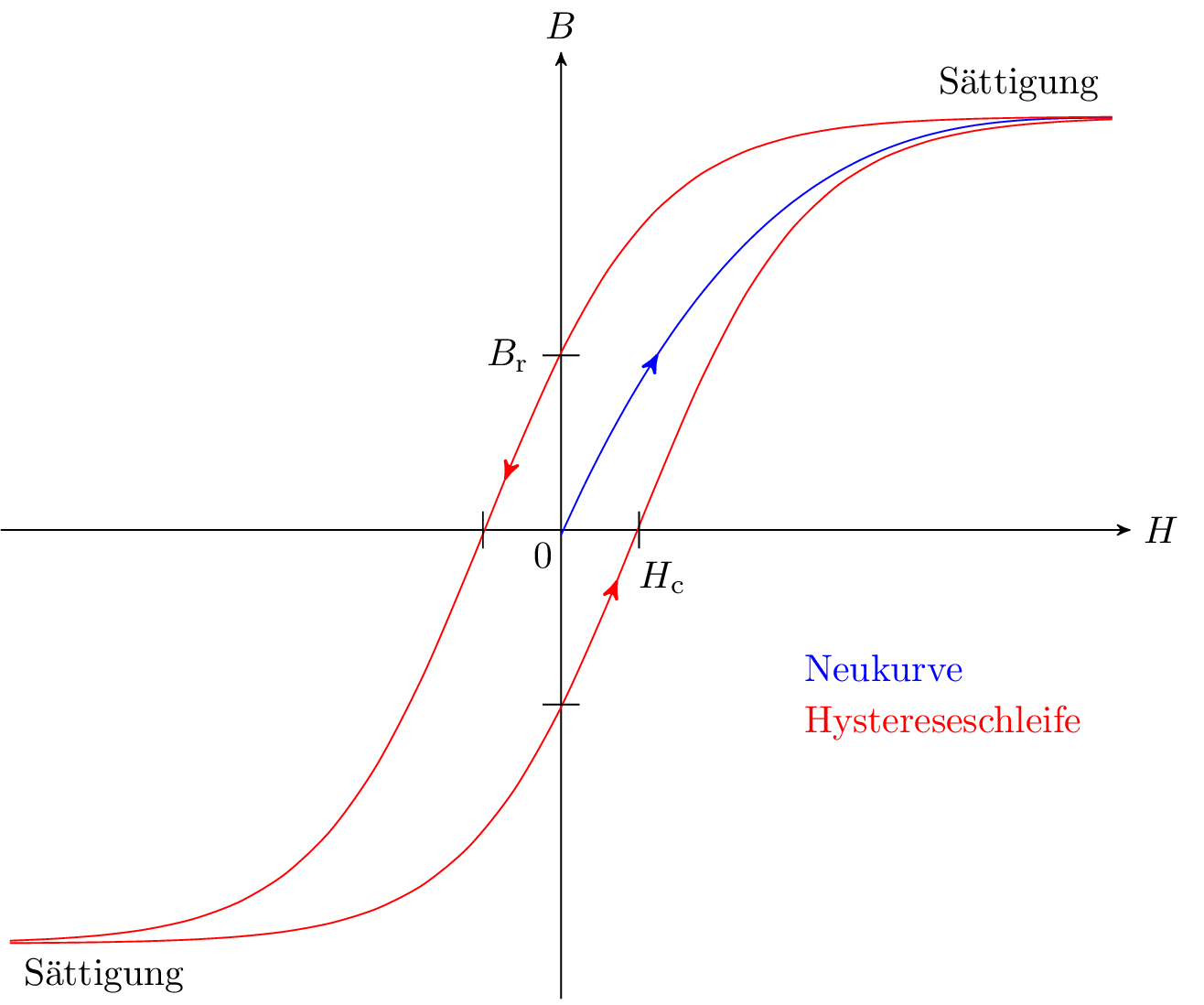
Ferromagnetic materials are divided into hard and soft magnetic materials based on their coercive field strength. Hard magnetic materials (e.g. strong permanent magnets made of neodymium-iron-boron) have a value for \(H_{\mathrm {c}}\) greater than \(10\cdot 10^{3}\,\ frac{\mathrm {A}}{\mathrm {m}}\), while for soft magnetic materials (e.g. magnetic cores made of manganese-zinc ferrite), \(H_{\mathrm {c}}\) is less than \(500\,\frac {\mathrm {A}}{\mathrm {m}}\). Hard magnetic materials are mainly used for permanent magnets.
Magnetic flux density Inside a tightly wound toroidal coil, a magnetic field strength of \(H=100\,\frac {\mathrm {A}}{\mathrm {m}}\) is to be generated. The coil has an average radius of \(5\,\mathrm {cm}\).
- 1.
- Calculate the required current \(I\) if the coil has \(N=200\) windings.
From Formula ?? and ??: \begin {align*} \varTheta & = H \cdot \ell _{\mathrm {m}} = N\cdot I \\ I & =\frac {H\cdot \ell _{\mathrm {m}}}{N}=\frac {100\,\frac {\mathrm {A}}{\mathrm {m}}\cdot 2\cdot \pi \cdot 5\cdot 10^{-2}\,\mathrm {m}}{200} = 157,08\,\mathrm {mA} \end {align*}
- 2.
- How large will the flux density \(B\) be in the case of an air coil (\(\mu _{\mathrm {r}}=1\)) or an iron-filled coil (\(\mu _{\mathrm {r}}=2000\) at the operating
point)?
From Formula 3: \begin {align*} B_\mathrm {Luft} & = \mu _0\cdot \mu _{\mathrm {r}}\cdot H = 1,256\cdot 10^{-6}\,\tfrac {\mathrm {Vs}}{\mathrm {Am}} \cdot 100\,\tfrac {\mathrm {A}}{\mathrm {m}} = 125,6\,\mu \mathrm {T} \\ B_\mathrm {Eisen} & = 2000\cdot B_\mathrm {Luft} = 251,2\,\mathrm {mT} \end {align*}
Magnetic resistance
Magnetic tension, also known as flux, was already discussed in chapter ??, and magnetic flux, which is the equivalent of electric current, was discussed in chapter . It therefore stands to reason that, in a magnetic circuit, there is also magnetic resistance, which is equivalent to ohmic resistance. It has the formula symbol \(R_{\mathrm {m}}\) and the unit \(\frac {\mathrm {A}}{\mathrm {V}\mathrm {s}}\) and is also called reluctance .
An example of a magnetic circuit is shown in Figure ?? by a simple iron ring with a single-sided coil. The coil generates a magnetic flux \(\varTheta \) analogous to electrical voltage. The iron circuit consists of four partial resistances, since the magnetic resistance depends on both the length and the cross-section through which the current flows. The four resistances are traversed by the magnetic flux \(\varPhi \).
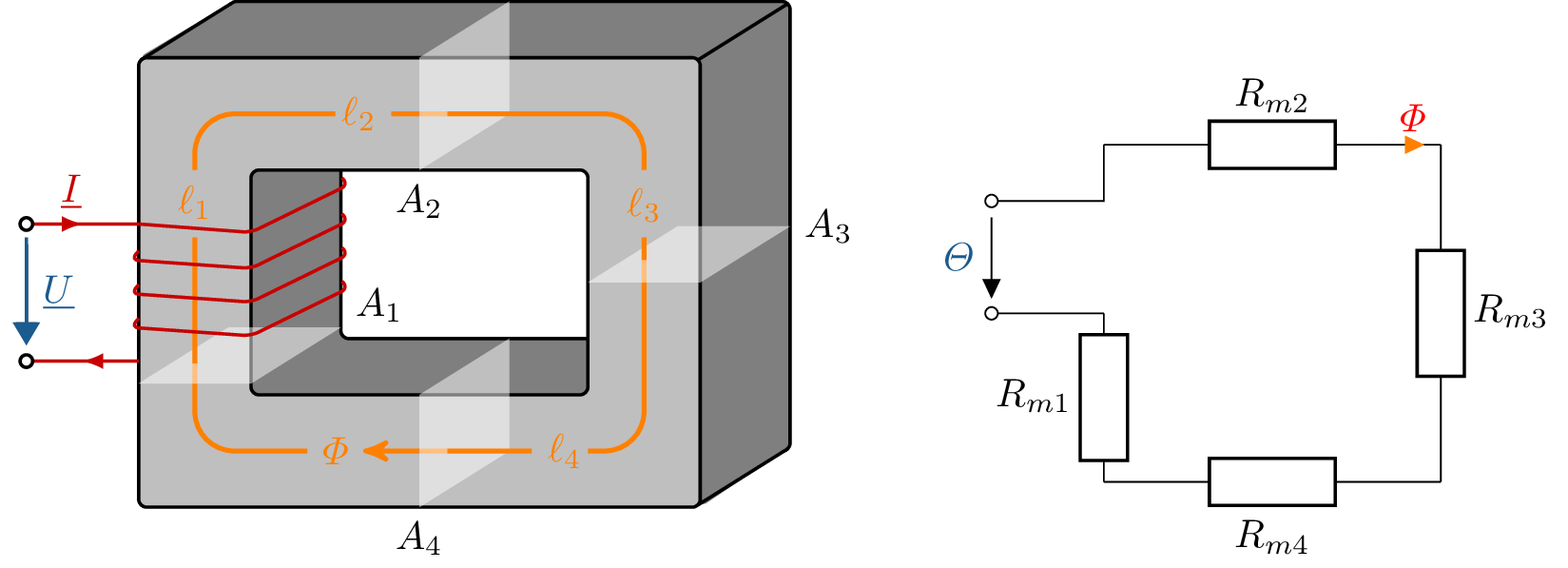
In simple arrangements (as shown in Figure ??, for example), the resistance can be expressed by equation 1, neglecting the corners. As with the magnetic field strength, \(\ell _{\mathrm {m}}\) is the average field line length of the resistance within the magnetic circle. To determine the average field line length \(\ell _{\mathrm {m}}\), the lengths of all sides are added together. \(A\) is the cross-sectional area through which the magnetic flux flows. \(\mu \) is the permeability of the material. The magnetic resistance \(R_{\mathrm {m}}\) is now calculated from the sum of the mean field line lengths \(\ell _{\mathrm {m}}\) divided by the product of the cross-sectional area \(A\) through which the magnetic flux flows and the permeability \(\mu _{\mathrm {r}} \cdot \mu _0\).
\begin {equation} R_{\mathrm {m}} =\frac {\ell _{\mathrm {m}}}{\mu _{\mathrm {r}}\cdot \mu _0\cdot A} \qquad \left [\frac {\mathrm {A}}{\mathrm {V}\cdot \mathrm {s}}\right ]\label {GlmagnWiderstand} \end {equation}
Key point: Magnetic resistance
To calculate the magnetic resistance \(R_{\mathrm {m}}\), the average field line length \(\ell _{\mathrm {m}}\) is divided by the product of the permeability of the material \(\mu _{\mathrm {r}}\cdot \mu _0\) and the cross-sectional area \(A\). If the material properties or cross-sectional areas within the magnetised body vary, the partial resistances are first calculated and then added together to give the total resistance.
1 The magnetic circle
If we now consider all known magnetic quantities in their interaction, we obtain the magnetic analogue of Ohm’s law. It describes that the magnetic voltage \(\varTheta \) corresponds to the product of the magnetic resistance \(R_{\mathrm {m}}\) and the magnetic flux \(\varPhi \). \begin {align} \varTheta &= R_{\mathrm {m}}\cdot \varPhi \end {align}
Key point: Relationships between magnetic field magnitudes
The magnetic field strength \(H\) in the special case of a toroidal coil is calculated from the product of the number of turns \(N\) and the current flow \(I\), divided by the mean field line length \(\ell _{\mathrm {m}}\).
\begin {equation*} H=\frac {N\cdot I}{\ell _{\mathrm {m}}} \end {equation*} The magnetic flux density \(B\) is determined by multiplying the magnetic field strength \(H\) by the permeability \(\mu _{\mathrm {r}} \cdot \mu _0\).
\begin {equation*} B = \mu _{\mathrm {r}} \cdot \mu _0 \cdot H \end {equation*}
The magnetic flux \(\varPhi \) is obtained from the integral of the magnetic flux density \(B\) over an area \(A\). \begin {equation*} \varPhi = \iint _A \vec {B} \cdot \mathrm {d} \vec {A} \end {equation*}
